Property Marketing
Commercial Property Marketing Plan: A 21-Day Launch Playbook
A practical 21-day commercial property marketing plan covering positioning, offering materials, launch channels, broker outreach, and campaign measurement.

In this field note
A commercial property launch is not a single email and a PDF attachment. It is a coordinated sequence that turns raw asset information into a clear investment story, puts that story in front of the right buyers, and gives the deal team useful feedback while momentum is highest.
Days 1–3: Define the assignment before designing anything
Start by aligning the owner and brokerage team on the business objective, likely buyer, timing, confidentiality requirements, approval process, and definition of a qualified response. A beautiful campaign cannot correct an unclear assignment.
Write the opportunity in one sentence, then list the facts that make it credible. Those proof points should come from approved source material such as leases, rent rolls, operating statements, surveys, market research, and property documentation, not assumptions carried over from an old brochure.
- Name the primary and secondary buyer profiles.
- Set the process: open bid, call for offers, priced offering, or direct negotiation.
- Create one approved fact sheet for figures used across every channel.
- Assign one decision-maker for consolidated comments and final approval.
Days 4–7: Build a specific investment story
The strongest story is rarely “great location” or “excellent opportunity.” It connects the asset, market, income, and business plan to a buyer’s reason for acting. A stabilized retail property may lead with income durability and trade-area strength. A vacant industrial building may lead with functional scarcity, access, and replacement cost.
Separate facts from projections. If the strategy depends on lease-up, renovation, mark-to-market rents, redevelopment, or expense savings, label the assumptions and show how they connect to the opportunity. Credibility increases when upside is presented as a testable case rather than a guaranteed outcome.
A useful test: if the property name and city were removed, would the opening paragraph still describe dozens of other listings? If so, the positioning is not specific enough.
Days 8–12: Produce one connected campaign system
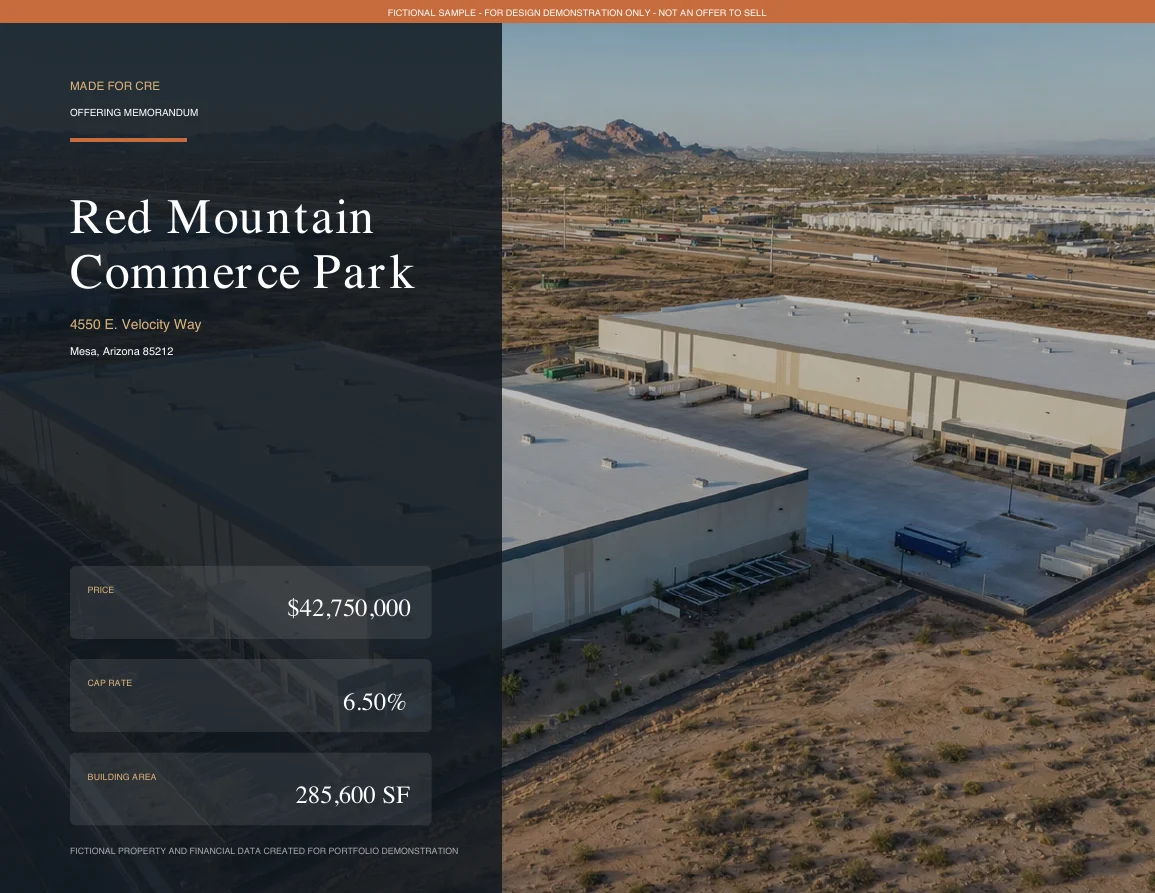
Build the offering memorandum, property page, email, broker package, maps, social graphics, and data-room structure from the same approved story and facts. The pieces should feel related, but each should be edited for its job rather than copied word for word.
The property page should communicate the basic opportunity before requiring a download. The OM should support deeper evaluation. The email should earn the click. Maps and aerials should make the location case. Financial exhibits should help a reviewer reconcile the thesis with the numbers.
- Hero photography or aerial with a clear asset view.
- Executive summary and property facts that match across all materials.
- Regional, submarket, and site-level mapping where relevant.
- Financial tables rebuilt for legibility and clearly labeled assumptions.
- A mobile-friendly property page with broker contacts and one next step.
Days 13–14: Run a launch-quality review
Review the campaign as a buyer would experience it, not file by file. Click from the email to the property page, request the materials, open the PDF on a phone, test broker contact links, and confirm that the current document is the one being delivered.
Then complete a separate factual review. Reconcile the address, acreage, square footage, tenancy, dates, pricing guidance, financial periods, broker information, and disclosures against the approved source. Design proofing and fact proofing should be distinct steps.
Days 15–18: Launch in a deliberate sequence
Begin with the highest-priority buyers and brokers, then broaden distribution. Personal outreach should not wait until after a mass email. The first conversations can reveal objections, missing information, and positioning issues while the campaign is still fresh enough to adjust.
- Day 15: Direct calls and personal emails to priority prospects.
- Day 16: Segmented database email and listing-platform activation.
- Day 17: LinkedIn launch post with one strong visual and one clear takeaway.
- Day 18: Follow-up to engaged prospects and relevant cooperating brokers.
Days 19–21: Measure buyer signals and adjust
Campaign reporting should help the team decide what to do next. Track qualified inquiries, document requests, repeat visits, data-room activity, calls, tours, and feedback themes. Opens and impressions provide context, but they are not the same as buyer intent.
Use the first week of response to improve the campaign. Clarify a commonly misunderstood point, add a requested document, revise an underperforming subject line, or refocus outreach on the buyer group showing the strongest fit.
The launch is complete when the team has a reliable follow-up rhythm, not when the first email is sent.
Ideas for your next website or property campaign?
We would be glad to help you bring them to life.

Good work starts with a conversation
Your firm deserves a website that fits.
Custom design for the people, properties, and expertise that make your brokerage yours.